
Billy Joe Green
 Billy Joe Green Passing on his love of music to his children and grandchildren.
with the band’s lead guitarist, Martin Tuesday. After two years with the band, Billy Joe struck out on his own and began his independent career as rock and roll blues guitarist.
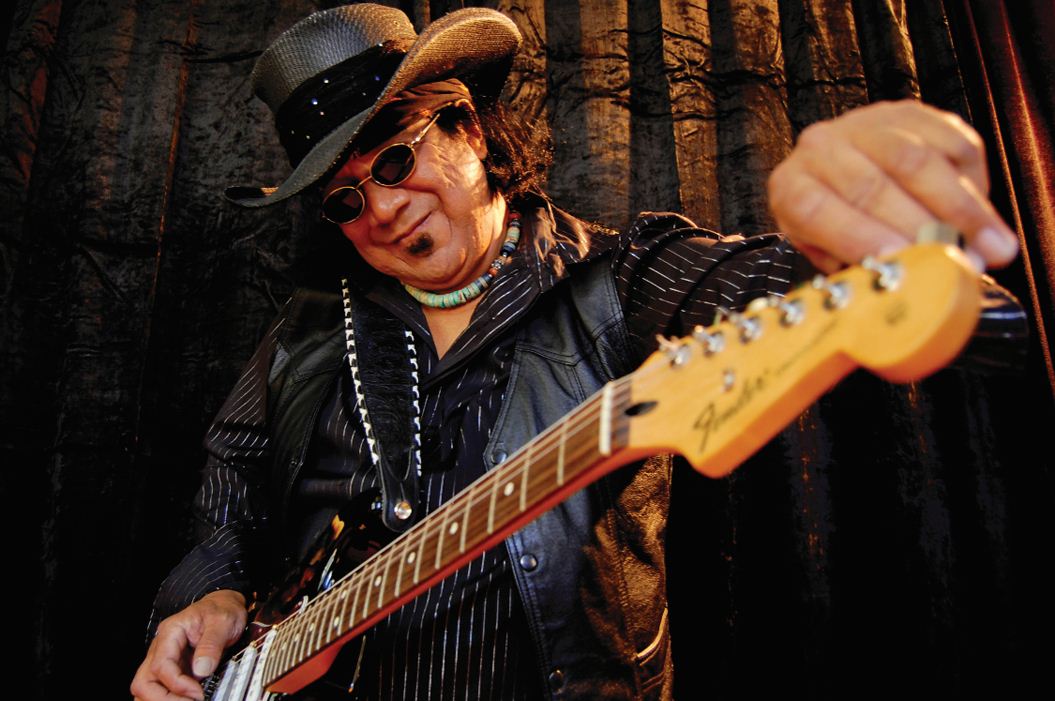 Over three decades later, he has recorded five CDs, the most recent is a CD/DVD called First Law of the Land. He has three JUNO nominations, a five-win sweep at the 2006 Winnipeg Blues.Com Music Awards, a 2006 Aboriginal People's Choice Awards ‘Best Blues’ CD Award, the ‘Best Male Artist’ at the 2002 Canadian Aboriginal Music Awards, a ‘Best Aboriginal Recording’ award at the 2001 Western Canadian Music Awards, and countless other nominations. Based in Winnipeg, Billy Joe continues to pursue his love, passion and devotion for the electric guitar. And like his father before him, Billy has managed to pass on his love of music to his children and grandchildren.
Return to Creator
When Billy Joe was sent to residential school and taken from the lifestyle that he loved, he misread the situation and felt that his parents had abandoned him. He began to build resentment towards them for abandoning him to the system. And he kept these feelings of resentment with him until mid-life, when he realized that what had happened was not their fault, nor was it his. But for many years this resentment was killing him, and it was instrumental in Billy developing an alcohol addiction.
The turning point for Billy Joe was when he rediscovered his culture and realized that alcoholism was merely a symptom of what was wrong. From his experiences at residential school and from the religious instruction he received at school, he felt he was being “lead down a path that did not belong” to him and it didn’t fit with who he really was. Eventually, Billy came to see that in order to heal himself he had to go back to who he really was; the self-identity that had been all but destroyed by the colonization process. Luckily, he had a mentor, Elder Peter Ochiese who helped him to recover from the pain and shame that came with alcohol addiction by teaching him traditional Anishnaabe ways. There was a “magical moment” in Billy’s recovery; his spiritual awakening. It happened when Peter Ochiese came to Manitoba to conduct a special ceremony. Billy made the trip to where the ceremony was being held and he was supposed to fast four whole days. But he “tripped up” and didn’t finish the four-day fast. Feeling like a failure, he jumped in his van and drove back to the city. When he got home and unpacked his bag, he found an eagle feather with four colours. As he held the sacred object, he knew without a doubt, that no-one (human) could have put it there because it definitely was not there before he left the ceremony. Billy took the gift of the feather as a clear sign that even though he didn’t complete his fast, he was “spiritually connected” and where he was “supposed to be”.
Billy Joe feels that he was given the gift of music to carry a message. He wants “Indian” people not to blindly accept the culture and the systems that were taught in the residential schools. He encourages them to go back to “Great Spirit”, to “Creator”, to their languages, their customs and values, and their identity as “tribal people”. He also believes that North American Indians are the last of the tribal people and that we have a “duty to revive the tribal law”. His last recording project was entitled, First Law of the Land: if Broken Return to Maker. With this recording and DVD project, Billy Joe is bringing people’s attention to his people’s history and to the ‘First Law of the Land’. It is this law that he says, overrides the law that the colonizers of North America used to claim the land for their own. Billy believes that this original law needs to be re-implemented and that we have the power to resurrect it. He encourages people, especially youth to go to his Facebook page, to view his DVD presentation and to learn more about how this law can be implemented.