
Marcia Chickeness
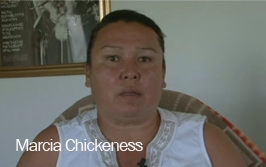 Marcia Chickeness Expressing her artistic ideas and visions
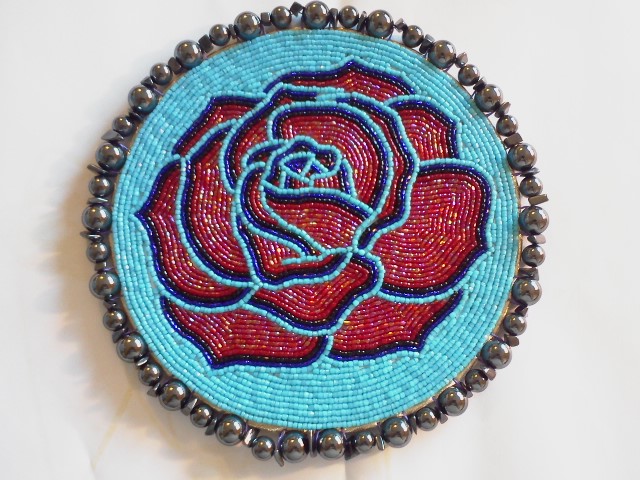
Marcia Chickeness is a Cree/ Assiniboine from Poundmaker First Nation. She was raised by her maternal grandparents in the traditional Cree way. When she was five years old however, Marcia was taken to residential school because her grandfather had passed away and her grandmother was too ill to look after her. Marcia stayed at residential school until she was eleven years old, and then went to live with her mother and step-father.
Initially, Marcia thought she would become an English teacher or Phys Ed teacher, but when she went into the sweat for the first time, she knew she had to become an artist in order to express the visions she experienced. At first she thought she could become a painter, until an elder suggested that she shouldn’t draw her spiritual visions, since they were sacred. But as Marcia became involved with her culture around the age of eighteen, she learned not only traditional teachings from a group of women but she learned the art of beading. Through her beadwork, Marcia found that she could express not only her culture, but the artistic ideas and visions that come from her “Grandfathers” and “Creator”. She feels that there is “spirituality to Indian art work” and the bead work should, “elevate you” as you look at it. The work is not simply art for art’s sake, but rather a celebration of life, and a teaching tool to take us to a higher plane.
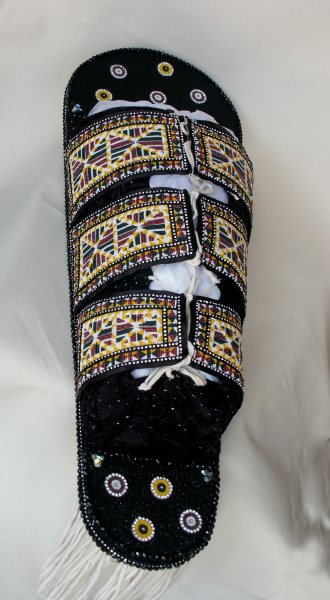 Marcia’s art work was featured in the “Clearing a Path”- new ways of seeing traditional Indigenous art” exhibit, which toured Saskatchewan for several years. The exhibit represented the province of Saskatchewan at the Cultural Olympiad in Vancouver, British Columbia. The exhibition also became a book, Clearing a Path- new ways of seeing traditional Indigenous art, published by University of Regina, Canadian Plains Research Centre. Her work was seen in Through the Eyes of the Cree, an award- winning exhibition at the Allen Sapp Gallery in North Battleford, Saskatchewan. Marcia is the mother of eight children and grandmother to five grandchildren.
Touching Souls
Despite being separated from her grandparents by being sent to residential school at such an early age, Marcia was able to reconnect with her traditional teachings and remember the guidance of her grandparents. Although her life was not easy and she endured “many hardships”, she never gave up. Fortunately, she was able to reconnect with her culture and ceremony when she was eighteen and experienced her first sweat ceremony. Marcia says it was during the ceremony that she realized with total shock, that the “Grandfathers” were there “all the time”, that they “never left us”, and they were always “keeping an eye on our people”. From that realization, Marcia began her own cultural reclamation, and her artistic and spiritual journey really began.
According to Marcia, both “art and spirit are in the same world”, there is no hypocrisy or “negative energy” in art. When she is doing her art she never feels bad or that she is “doing anything wrong” and she never feels like she wants to “give up” on the piece she is working on, or her quest for self expression.
Marcia strives for perfection in her art. She treats the beads and designs with great respect because she believes that they come from the Creator and that her artistry is a gift, a blessing. Her source of inspiration, the love she feels from Creator, will never fail, and that is why she keeps going. “I will still be an artist at eighty years old”, she declares.
Beyond achieving a high level of technical ability, Marcia wants to make her artistic creations be more than merely beautiful objects that are lovely to look at. She hopes that her work will touch the viewer in a deeper way. In her series of cradleboards, she took a traditional form, an almost universally recognized and evocative object, to be her canvas. On this three-dimensional canvas, she wanted to “touch souls” with her use of colour and design. Each bead and each stitch she imbued with her vision and desire, so that the end result was quite extraordinary. One such cradleboard she chose to call “Residential School Baby” because she wanted to celebrate her survival of time in the oppressive institution. She wanted to let people see “how my life turned out”, and that despite being almost destroyed, her life and her culture were beautiful and inspiring.
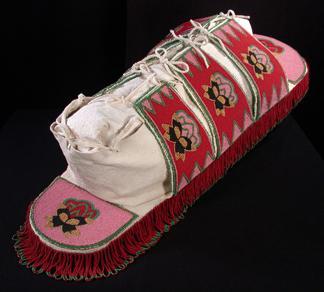 She says at times she feels like she is cheating because the inspiration for designs and the ideas come so easily to her. But she is aware that she is not doing anything; it is all coming from her Creator. Working on her art fills her with positive energy because she is working at the level of her spirit, her soul; so much that she would never dream of being anyone else except herself.
This is a far cry from what she experienced in residential school where she always felt she was being encouraged to “throw away” her language and her culture. But Marcia intuitively knew it was wrong, not to mention impossible to “throw away who you were”, as she says. So she returned to her culture, to the ways of those who raised her and went back to where she knew her life would, “have more purpose and meaning”; a rich life as a proud Cree Assiniboine woman.
Visit the Allan Sapp Gallery