
William Quinn
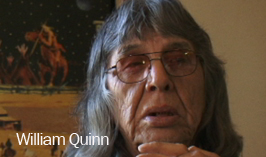 William QuinnHelping others to heal
 William (Bill) Quinn is Cree and a member of the Saddle Lake Nation, in Alberta. His mother passed away when he was three years old and he was raised by his grandmother until he reached the age of seven. Bill considers himself very fortunate to have been raised by a “Native American woman” because she not only cared for and loved him, but taught him the Cree language, the Cree philosophy of life and value system. He was taught how to live in the natural world, to have respect for all forms of life and above all, she emphasized the concept of tapwewin or “speaking the truth”. To Bill, the word, tapwewin meant to always maintain “truth, total honesty” in all of one’s speech and behavior.
Upon reaching school age, Bill and other children from the area, were loaded up onto a pick-up truck taken to boarding school and it was this disruption in his young life that caused him to lose “everything my (grand) mother taught me”. For the next ten years, Bill was interned in the Blue Quills Indian Residential School in St. Paul, Alberta and trained in farm and maintenance work. His education was not much beyond religious and light maintenance training. He says he doesn’t remember any one at the school ever encouraging him to follow his interests in the sciences to become say, a doctor. He left school at the age of seventeen with the equivalency of Grade 7, and still misses the higher education he never got.
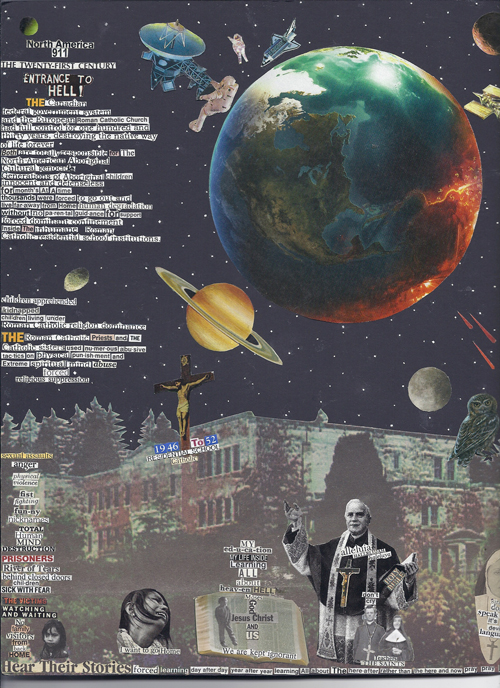
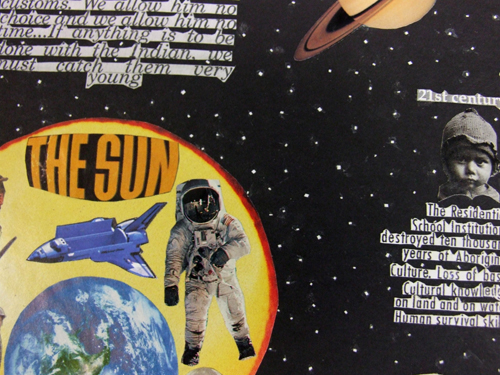
Much later in life Bill discovered his creative talents and began to make large collages. One day he was reading a newspaper and had the inclination to cut out images and words, then to rearrange them, and glue them onto paper. He found that the process of creating art was not only very therapeutic for him, but by sharing his story through the collage art work, he discovered it had the potential to help others heal, “some of the inner wounds that so many of us First Nations people are burdened with”. Bill currently lives in Vancouver, British Columbia where he has developed his artistic practice and also shown his work publically. He also serves as an elder for the community both in Vancouver and in his home territory of Alberta.
“tapwewin” Speaking the Truth
Bill says at residential school he learned to be the total opposite of what his grandmother had taught him; he became “mean, a liar and a thief”. Whereas she had taught him never to harm anyone or anything, he very quickly learned to be a fighter and violence became part of his life. Bill claims that at one point he was being beaten three times a day. He did attempt running away from the school, but he was caught and his punishment was to have his head shaved. The feelings of shame and embarrassment from that incident stayed with him for many years.
Almost immediately upon release from school, Bill began a life long battle with addictions: chronic alcoholism, drug addiction. He was also incarcerated on a number of occasions, a result he feels of his addictions. Bill tried many times to turn his life around, but it wasn’t until he reconnected with the teachings of his grandmother and his natural “way of being” that he was able to finally get clean.
This is Bill’s description of how it happened:
“I started to think about my upcoming release date (from jail) and in my depressed state, my thoughts centered on my Grandmother and all of her good words. I hadn’t been home in nine years and I yearned to see my Dad and my brothers. I also planned on staying sober. Upon my release, I somehow ended up in Edmonton’s skid row where I drank for 4 days straight. I remember waking up in a room that was sparsely furnished with a little single bed and a dresser with a mirror mounted on it. I got up and looked at myself in the mirror. My eyes were bloodshot, and I thought, ‘Every time something awful happens in my life it is because of alcohol.’ I stayed sober for 4 months and (then) drank again”.
 But in that moment at the mirror, the seed was planted. Bill says that as he looked at his reflection, he came “face to face with his grandmother’s teaching”, which was to tell the truth. He says he felt, “a feeling, a rush, go through my body”. It was that connection to truth, or his grandmother’s spirit, or perhaps to his higher Self that allowed him to eventually quit alcohol, heroin, taking pills and even smoking. He now has over 30 years of sobriety.
Bill’s art is intensely political. It is provocative, emotional and his unique version of tapwewin, or truth-telling. He has found a way to express his feelings of hurt and anger at what was lost through colonization, not only in his life, but also in the whole North American Indian experience. And despite being almost destroyed by his traumatic experiences, Bill is far from resentful. He is a positive and generous man who maintains optimism and an open heart. Now in his seventies, he continues to teach, to help others with addiction problems, and he even attends the occasional protest or demonstration on issues that he feels are important. Bill feels passionately that we need to work together as a group of people, because “this planet is our home”, and “we all have the responsibility” to ensure the future generations have a better life. He encourages “all of us somehow”, to “share whatever we can”, and “get out there and help”. He wants people to look at his art and to ask, “Do we continue this way? Or do we do something about it?”