
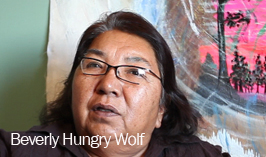
 Beverly Hungry WolfA passion for her language and culture.
 Billy Joe Green Passing on his love of music to his children and grandchildren.
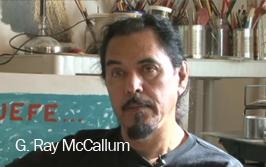
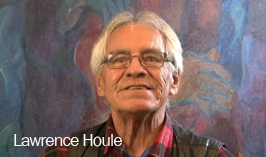 Lawrence 'Teddy Boy' Houle Passing on his fiddling style and repertoire
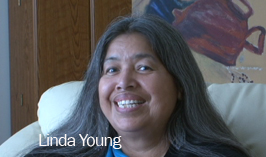 Linda Young Sharing her language and culture
 Louis OgemahA catalyst for “Indian” art in Western Canada.
 Lyndon TootoosisThe arts as a vehicle to drive change
 Marcia Chickeness Expressing her artistic ideas and visions
 Sally MilneReconnecting with the cultural ways and teachings.
 William QuinnHelping others to heal
Lawrence 'Teddy Boy' Houle Passing on his fiddling style and repertoire
Lawrence "Teddy Boy" Houle or Tay-basse-gay-inini, "One Who Brings the Bright Light to a Point" is Anishnaabe from the community of Ebb and Flow, Manitoba. Music has been a part of his life from a very early age. Using a fiddle that he secretly took from his step-dad, a six-year old, "Teddy Boy" impressed his step-father and mother by playing the entire song, Red River Valley with only one string; the "E" string. From then on, he was allowed to play the fiddle any time he wanted, as long as he "looked after it". He certainly did, and as he says, "he has been looking after it better than anyone" ever since.
Despite the success Lawrence had with his musical education, his experiences in formal schooling were abysmal. Lawrence spent three whole years in Grade One and eventually quit school for good at age thirteen after completing Grade Eight. Lawrence speaks two languages fluently and understands a third. He eventually studied at university where he learned how to "research", and at any given time he has at least "three hundred fiddle tunes" in his head. These tunes are rare traditional old-style songs, dating back to the fur trade and beyond. Lawrence has traced at least five generations of fiddle-playing ancestors all the way back to Scotland and made the link to their Scottish fiddle music.
Lawrence has performed at festivals nationally and internationally, even performing at Carnegie Hall at the 100th Anniversary of the Hall. He has released two CD's and appeared on various Aboriginal music collections and films. At 73 years of age, Lawrence is still very active, passing on his fiddling style and repertoire to young people who are eager to learn. He is also an elder and ceremonialist; travelling all over Western Canada to share his experiences and Anishnaabe culture with those who ask.
Manoo-ngoosns "It's Okay Son"
Lawrence lost his father at an early age and it affected him deeply. His mother remarried a man who did not seem to care about the young Lawrence, and that made the absence of his father even more poignant. But when his mother would notice that her 'Teddy Boy' was sad or angry, she would say "manoo-ngoosns" to him. This was her way of telling him to look for the good in the situation, the positive-ness in life. This teaching from his mother has stayed with Lawrence for his entire life. Today he simply glows with the joy of living. He loves and accepts himself completely and believes that "Creator never put anything bad in the world"; it is only the way we look at things that make them positive or negative. This is a far cry from the bitter, resentful man who hated himself, and found it next to impossible to look at his reflection in the mirror.
His journey of self-healing began when he realized that first and foremost, he had to learn to forgive himself. He came to understood that what happened to him in life was not his fault. Although Lawrence never went to residential school himself, all of his relatives went and this affected him profoundly. From his adult perspective, he could see that children are not responsible for what happened to them, and they are innocent. They were forcibly taken by law and so they did not in any way cause what happened to them. For many years he had internalized feelings of shame and self-hatred and those feelings lead him to alcoholism. Although he had been given his Anishnaabe ceremonial name and a sacred pipe at the age of twelve, he had been convinced by school and the church that his Anishnaabe ways were bad, and that he was a sinner. His traditional values and way of life had been taken from him and he felt "spiritually bankrupt". And his lifestyle as a drunk left him feeling completely unworthy to practice his traditional ways. However, when Lawrence was thirty-seven, desperate for a better way of living, he once again sought to reconnect to his Anishnaabe way of life. During ceremony, he took his sacred bundle and his pipe, and began to rebuild a spiritual practice in the way of his grandfathers and grandmothers.
Lawrence recommends that you come to know who you are completely; both good and bad. Cleaning out resentments was the next step, and only after he was able to forgive himself, did he begin to forgive those whom he felt had harmed him in the past. Healing his past allowed Lawrence to become free of negative feelings and he was able to move forward in his life in a positive way. Even though Lawrence can now say that he "is the most unique person" he knows, and that he loves himself, he is also quick to point out that if "you don't love yourself, how can you possibly love another person?" And if you are not honest with yourself and respect yourself first, you won't be able to have that for others. So the healing process he suggests must begin with the Self first, and then it can spread out from there.
Lawrence is the first person to say that he doesn't teach, but rather he shares only what he has experienced, which is the only thing that he feels that he is qualified to share. Most prominently of those are his music, and his Anishnaabe culture. In addition to playing and performing music and sharing what he knows about the fiddle and songs, he also shares his Anishnaabe traditional ways, the language, and ceremonies in his role as an elder. He is always willing to conduct workshops in communities if he is invited. Lawrence says that if he has "anything you want" that he is willing to share it because that is his "purpose in life", to give back.