
 Beverly Hungry WolfA passion for her language and culture.
 Billy Joe Green Passing on his love of music to his children and grandchildren.
 Lawrence 'Teddy Boy' Houle Passing on his fiddling style and repertoire
 Linda Young Sharing her language and culture
 Louis OgemahA catalyst for “Indian” art in Western Canada.
 Lyndon TootoosisThe arts as a vehicle to drive change
 Marcia Chickeness Expressing her artistic ideas and visions
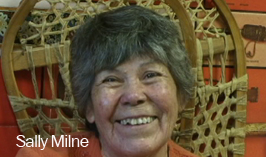 Sally MilneReconnecting with the cultural ways and teachings.
 William QuinnHelping others to heal
Sally MilneReconnecting with the cultural ways and teachings.
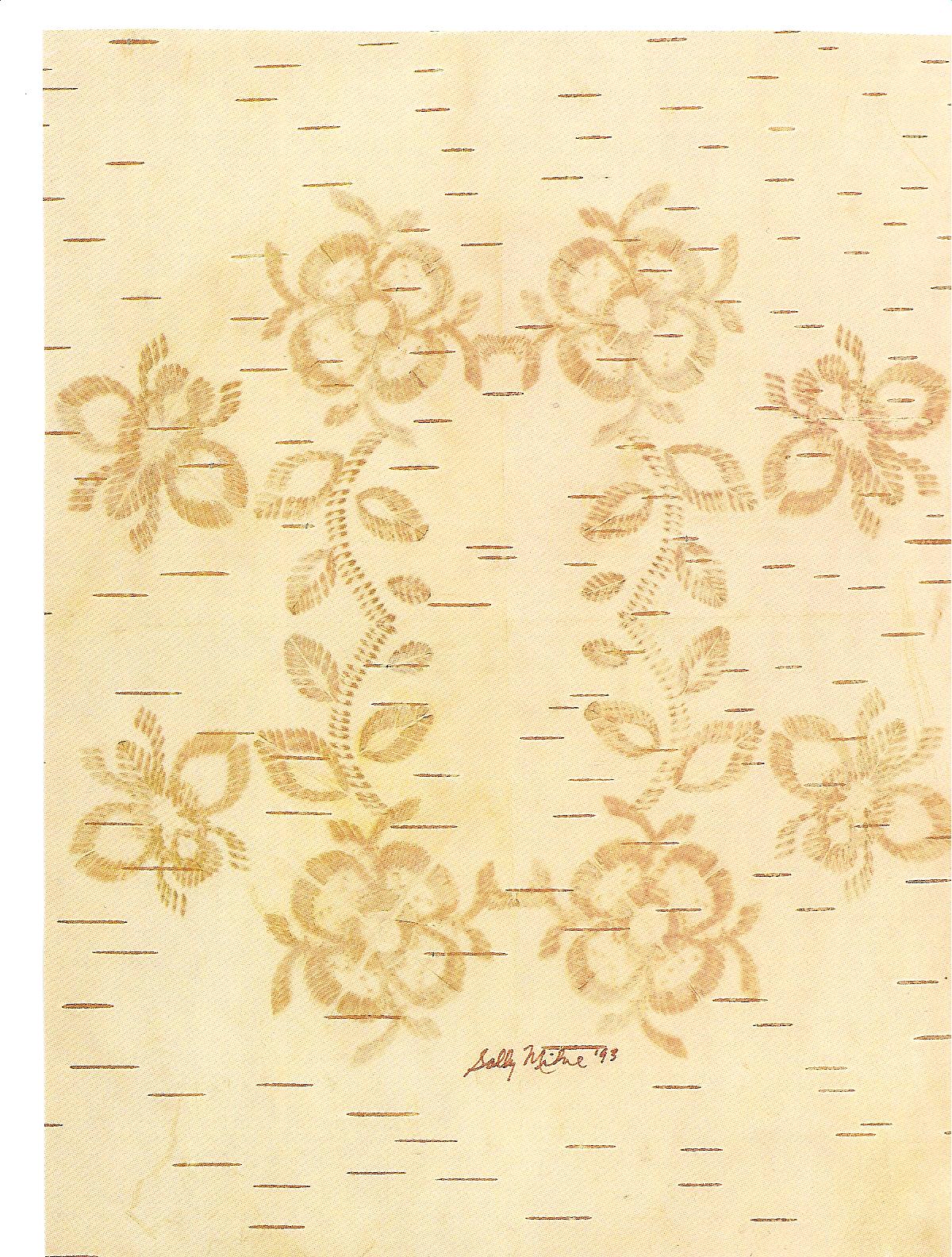
Sally Milne is Cree and was born in Stanley Mission, Saskatchewan. She lived with her parents and ten siblings on an island near Stanley, but mostly followed the family trap lines up and down the Churchill River system. When she was twelve years old, she was sent down south to residential school in Prince Albert. Until that time, since neither of her parents had been to school, she spoke only the Cree language and was raised in the traditional ways of the Woodland Cree. Sally remembers all of the tasks she was doing by the age of five; sewing, cutting wood, and tending to the fish lines. But she never considered it as work; it was just "what you did". At about this time her grandmother showed her how to make birch bark bitings. Sally would return to practice this art form later in her life when she reconnected with the cultural ways and teachings of her childhood.
The opportunity to reconnect came when Sally worked as a cultural instructor in the early 80's. She began to teach the traditional crafts that she had learned during her former life on the trap line; not only birch bark biting, but moose hair tufting, basket making, porcupine quilling. It didn't become an artistic practice for her until a woman approached her once and asked if she would consider selling one of her bitings. It was then that Sally began to consider her birch bark biting as a legitimate art form. Art lovers and collectors agree; Sally's bitings can be found in public and private collections all over the globe. As one of the few remaining artists who have mastered the traditional practice of birch bark biting, Sally has become world-renown for her art. She has also been featured on a number of documentary television shows for her artistry and cultural talents. Sally is an elder and healer who specializes in treatment of people suffering emotional problems, especially children.
Birch Medicine
Sally didn't think of birch bark biting as artistic because it was a very common practice as she was growing up. Historically, the practice of biting or bruising birch bark with the teeth was done in order to create beading designs and patterns to replicate with beads or quills on baskets, clothing or household items. Like many aspects of her childhood life in the boreal forest, she took it as normal and not exceptional. It wasn't until she went to residential school that she had something to contrast it with.
In school, Sally felt absolutely terrified; she didn't speak English, she knew no one and felt humiliated by how she was treated. Everything was totally different from anything she had experienced before. Sally explains that because she grew up following the rhythm of nature, she didn't understand the concept of time or deadlines. Her mother's gentle advice had always been not to rush and to "take it easy" with whatever you were doing. As a result, Sally says she was always late at school and her arms were covered with purple bruises of repeated strappings, as she was being trained to be "on time".
After Sally's first year, her father became very alarmed at the behavioral changes in his children when they returned from school. Sally said that he and the older people, the grandmothers and great aunts noticed that the children were becoming aggressive and disrespectful; they were violent, both verbally and physically. This behavior, Sally says, was very unusual. When she was growing up, children were never spoken to harshly, never yelled at, or criticized. Everyone was treated with respect, gentleness, love and kindness. Indeed they were taught to "walk softly", to treat everything with respect, from the animals that gave their lives for food and furs, to the trees, land and water. The belief was that since everything and everyone was inter-related, what happened to one affected all.
Gradually, after spending time in residential school, Sally started to change too. Perhaps she started to see her family and former life as it was perceived by her educators and the non-Native community of Prince Albert. It could have been this disconnect from who she was that caused a tremendous self-loathing in Sally. So she, like many others, became addicted to alcohol or whatever would numb the pain. It wasn't until she came face to face with death at her own hands that she decided she needed, "to find another way to live". One of the things she did was to return to visit her family and people still living on the trap-line to see if they were really as backward as she had come to believe. She was delighted to discover that there was "absolutely nothing wrong with them".
Later, when Sally began teaching as a Cultural Instructor, and she needed to learn the traditional ways, she began to go to ceremonies like sweat lodges. It was there that she discovered that first of all if she was going to be a cultural teacher, she had to clean up her act and become a "good person". Because otherwise, she says, "you have no business in the traditional field". It's a case of being able to help yourself before you can help others. Sally made that commitment and although it "hasn't been easy", she has been able to heal herself and can now help others find what she has found by reconnecting to traditional beliefs and ways.