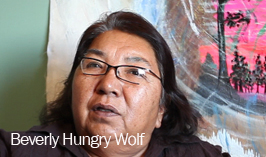
 Beverly Hungry WolfA passion for her language and culture.
 Billy Joe Green Passing on his love of music to his children and grandchildren.
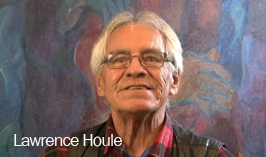 Lawrence 'Teddy Boy' Houle Passing on his fiddling style and repertoire
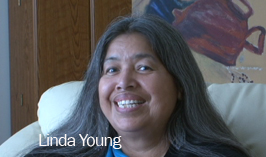 Linda Young Sharing her language and culture
 Louis OgemahA catalyst for “Indian” art in Western Canada.
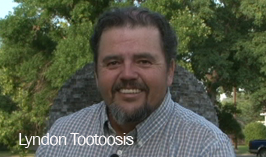 Lyndon TootoosisThe arts as a vehicle to drive change
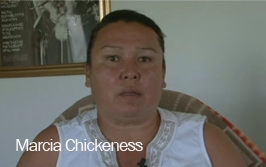 Marcia Chickeness Expressing her artistic ideas and visions
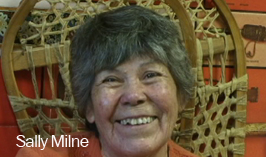 Sally MilneReconnecting with the cultural ways and teachings.
 William QuinnHelping others to heal
Linda Young Sharing her language and culture
Linda Young is originally from Onion Lake Cree Nation, Saskatchewan. She is the eldest in a family of ten children. Linda was raised by her great grandparents. But by the time she was five, her grandparents were getting quite old and they needed a break from raising children, so she was sent to St Anthony's Roman Catholic Indian Residential School. Linda feels that it was her vivid imagination and her ability to create her own inner world that allowed her to survive in the institutional setting. However her artistic growth was also being stimulated in the school environment; Linda was collecting a wealth of experiences and developed her imagination. She was stimulated by images in books, in church, film-strips, paintings, music classes (she learned to play guitar), drama and by reading and memorizing poetry. It wouldn't be until well after she had left school however, that Linda would return to the artistic expression that she had been training for her entire life; visual art. By the time she was in her forties, Linda had been a wife and mother and she had raised her children. But it wasn't until then that she started to get the idea that she might not "always be here", so she started to take her art practice seriously and began working as a visual artist.
Linda's shares her nehiyaw pimatsîwin; Cree language, Cree culture and history through her work as a multi-media artist. Her work has been shown in numerous galleries from the Mendel Art Gallery in Saskatoon, to most recently her installation at Sasipenita "never give up"-Honoring Strength and Endurance of First Nation and Metis Women at the Wanuskewin Heritage Park. She has a B.A. and B.F.A in Fine Art and Art History from the University of Saskatchewan as well as completing required coursework in the M.A graduate program in Art History.
As an advocate for nehiyaw pimatsîwin; Cree language, Cree culture, Linda not only passes on her Northern Plains Cree cultural legacy to her eight grandchildren, she instructs Aboriginal art history, she works a visual artist, and she is the "Kokum in Residence" at Confederation Park Community School in Saskatoon, where she shares her language and culture with hundreds of First Nations and non-First Nations students.
'maskihkîwin' Medicine Art
When she first arrived at residential school, Linda had a hard time believing that she couldn't go home and was no longer able to live the life that she was used to living. Residential school was a total "disruption" of her life as she knew it. But it was her strong imagination and the belief that someone somehow would "save" her, which kept her going. Linda also feels that she survived by connecting to nature. She learned at an early age how to escape by being out of doors; getting comfort from the trees, the wind, the smells of the prairie, listening to the insects, and by simply living in her own imaginative world.
Linda was also stimulated by the visual iconography of the Catholic school setting. She was surrounded by art work on the walls, scrolls portraying scenes from the Bible and saints, colourful pictures in books. Initially she couldn't speak the language, so she spent a lot time simply observing her new environment. For a highly imaginative young girl, a statue of Mary came "alive", and provided Linda with a sense of protection and security. And because she was brought up by her traditional Grandmother, she was very familiar with ceremony. Linda's grandmother was a healer and she often saw her gathering herbs and making teas and tonics, and even at a young age Linda understood the use of rocks, tobacco and cloth having seen them used in ceremony. So with that background, Linda says she could relate to the three-dimensional objects and religious statues that she saw at school.
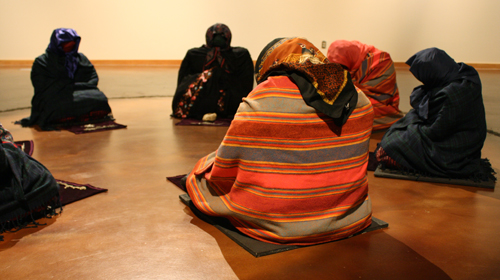
Many years later, these very statues would come back into Linda's life. In an interesting turn of events, when the residential school was torn down and its 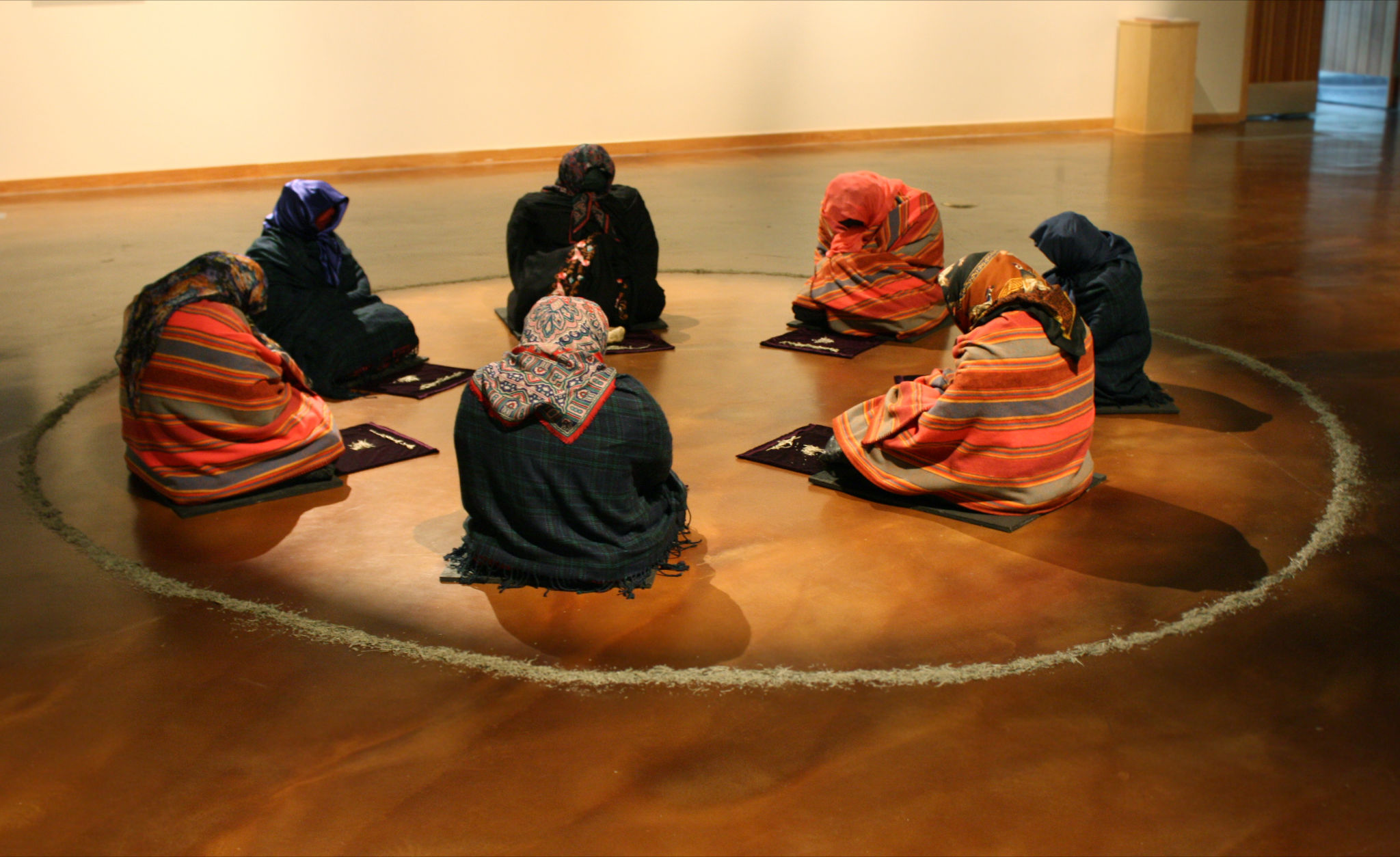 contents were either destroyed or dumped, Linda's sister was able to salvage a statue of Mary which Linda then used in an art piece. The cracked and glued statue was wrapped in red cloth and the piece was to commemorate people who have "experienced genocide". It was viewed by some as very political and even disrespectful to the church, but for Linda it was fundamentally about healing, which is the underlying motivation for all her art work. Linda feels that all of her art is about healing, and that it's a "reparative act". It's all about "fixing history" and healing.
The idea of using art to fix history perhaps came when Linda took a course related to one of her jobs. In this class she learned how to repair a bone fracture through guided meditation. For Linda it was a very valuable concept and one that she could apply to her artwork; it was possible to go back in time and repair what was broken or damaged. So now she uses that notion of healing in her art; whatever is fractured or disconnected in the past she says, "I go back and fix".
Through her artwork Linda is a healer, but she doesn't, in the way of her grandmother, gather herbs or medicines, instead she "paints" them. She says that she adds colours and "feelings" in the same way that her grandmother might have added certain herbs to a medicinal tea. Linda hopes that when someone looks at a particular piece, that it will evoke a feeling of understanding and the viewer will say," Oh...I know what that is" and that is might stimulate a process of healing and change.